Patience and Persistence
“Patience is not simply the ability to wait – it’s how we behave while we’re waiting” – Joyce Meyer.
By DAVE BERRY
Patience for a photographer can be a lonely virtue.
Sometimes the perfect photograph just isn’t there. And sometimes it never will be.
You can’t just walk out the door any time you want and shoot a sunset. You can’t wish the waves would break over the rocks when they won’t. You can’t shoot a full moonrise on an overcast evening. And you can’t make that blue heron wade in front of a better background.
But you have to try. Nothing happens without the attempt.
Sure, you need a decent camera, but not necessarily an expensive one. An iPhone takes amazing shots, but it’s not good for everything. A long lens brings you up close… but zooming in on a dull subject will probably result in a mediocre photo.
Having a good eye and being willing to stalk an elusive photo is vital. The rest is planning, preparation and patience.
It doesn’t always pay off. Like last year, on August 10, when I drove way too far stalking the perfect spot to shoot the “super moon,” the second of three in a row that would be extra big and bright. I had worked too late and missed the first, and I was determined to try out my new long lens on the second.
My circuitous route around Lake Palestine took me west, south, east, north and back east again. Should have done more advance work. None of a dozen spots worked if my iPhone app correctly pinpointed where the super moon would rise. But it was coming up soon, and I had to decide.
I chose a spot, but I would have to hike a bit. Parking off the road, I crossed the highway and a bridge spanning a small bay. In the half-light, the foreground was perfect, but it was going dark quickly. I was committed.
Avoiding the large spider that patrolled the guardrail, I traipsed through the weeds down the slope until I had a good angle. With my camera mounted on the tripod, I waited as dark came on. It was an enjoyable evening, but a cloudbank rose faster than the super moon. By the time it rose above the trees and the picturesque boathouses below, it was shrouded in a murky curtain of clouds. Across town, a photographer friend captured a perfect shot – from his back yard.
Sometimes it just doesn’t work out. But often, the effort itself is what makes memories. A few years ago, my wife and I explored Yosemite National Park. The first day was a perfect day in Yosemite Valley. I shot Half Dome amid autumn leaves, hiked to Bridal Veil Falls, picnicked at the base of El Capitan, and drove out of the mountains after dark. The following day, from the south entrance, we spent the morning amid the towering redwoods of Mariposa Grove and lazily explored the park as we drove toward the valley.
As the sun dropped lower in the west, we emerged from a tunnel at a crowded spot with the uninspiring name of Tunnel View. I wanted to shoot Yosemite Valley at sunset, and we were just in time.
At the rock wall, I realized I would have to squeeze in alongside dozens of cameras on tripods. I wasn’t the only one who admired Ansel Adams’ photos from this angle. But as two more tour buses disgorged 100 more cameras, I decided to seek higher ground. I’m not big on crowds, and taking the same photo as a hundred others didn’t appeal to me. My map showed a dotted line rising up the mountain to a spot overhead called Inspiration Point. It sounded promising.
Clambering over rocks and through the trees, I knew I was abandoning a sure photo for the possibility of a better one. As the trees closed around me, I worried I had made a mistake… but I kept climbing.
Soon the trail was a series of switchbacks around the mountain’s edge and I could no longer see the valley. Eventually the trail swung back, but there was no overlook. I worked up a sweat. My backpack was dragging me down. I kept climbing.
I found a spot where trees were sparse, where by climbing onto a boulder and holding tight to a stump, I might get my shot. The west slope of El Capitan was now in bright golden light as rays from the setting sun moved up the valley. Far down the valley, Half Dome remained in shadow. It wasn’t perfect, so I kept climbing.
Deeper in the trees again, the trail flattened out and began another series of switchbacks. I tried to estimate the distance to Inspiration Point, which I imagined as the magical place from which Ansel Adams took his iconic shot.

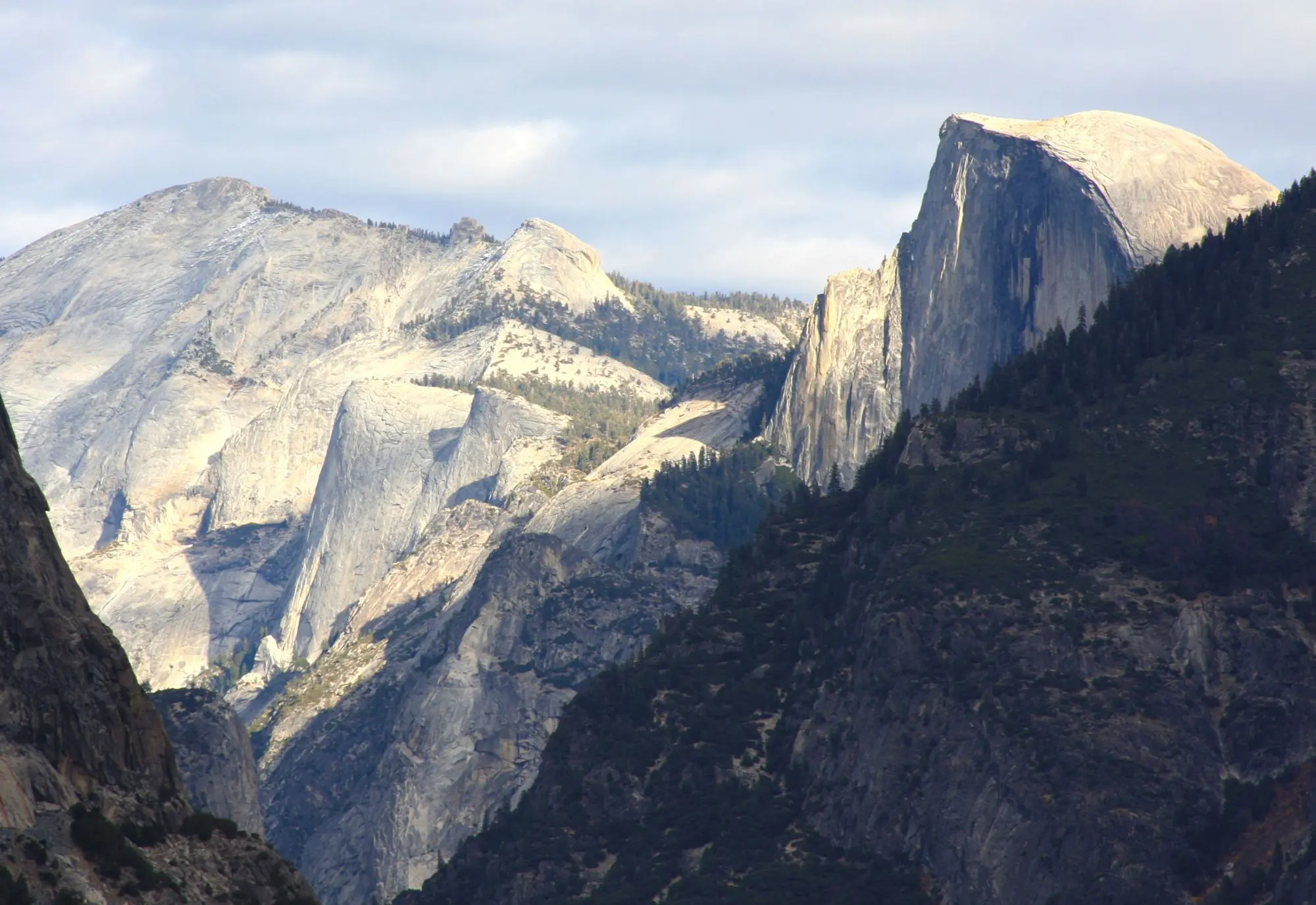
Through the trees, I saw the first glint of light on Half Dome. I had to decide – keep going or retrace my steps to that half-perfect spot. I elected to take the shot I knew I could get rather than bet on a more perfect one. Down the trail, near a stunted madrone tree I had visited with on the way up, I left the trail. Climbing onto a rocky ledge, I found a gap in the trees, settled atop a smooth boulder and snapped away as the sun worked its way down the valley. Half Dome was coming to life.
It was pure dumb luck the sun and clouds did what they did that day. And, I have to confess something. Back in the parking lot, as the tour buses were leaving and I reconnected with Marti, who was sitting on a rock ledge taking it all in, the sunset gave a last hurrah. That’s where I got my best shots.
But I wouldn’t trade the climb for anything. Alone on that slope, enjoying the beauty of Yosemite Valley, far above the highway and surrounded by the quiet music of the mountain, I had found my own bit of photographic magic.
###
Dave Berry is the retired editor of the Tyler Morning Telegraph. His Focal Point column appeared each Wednesday on the front of the My Generation section. (Published Feb. 14, 2015)
Photo: Sunset lights the peak of Half Dome in the Yosemite Valley in 2013. (Photo by Dave Berry)